
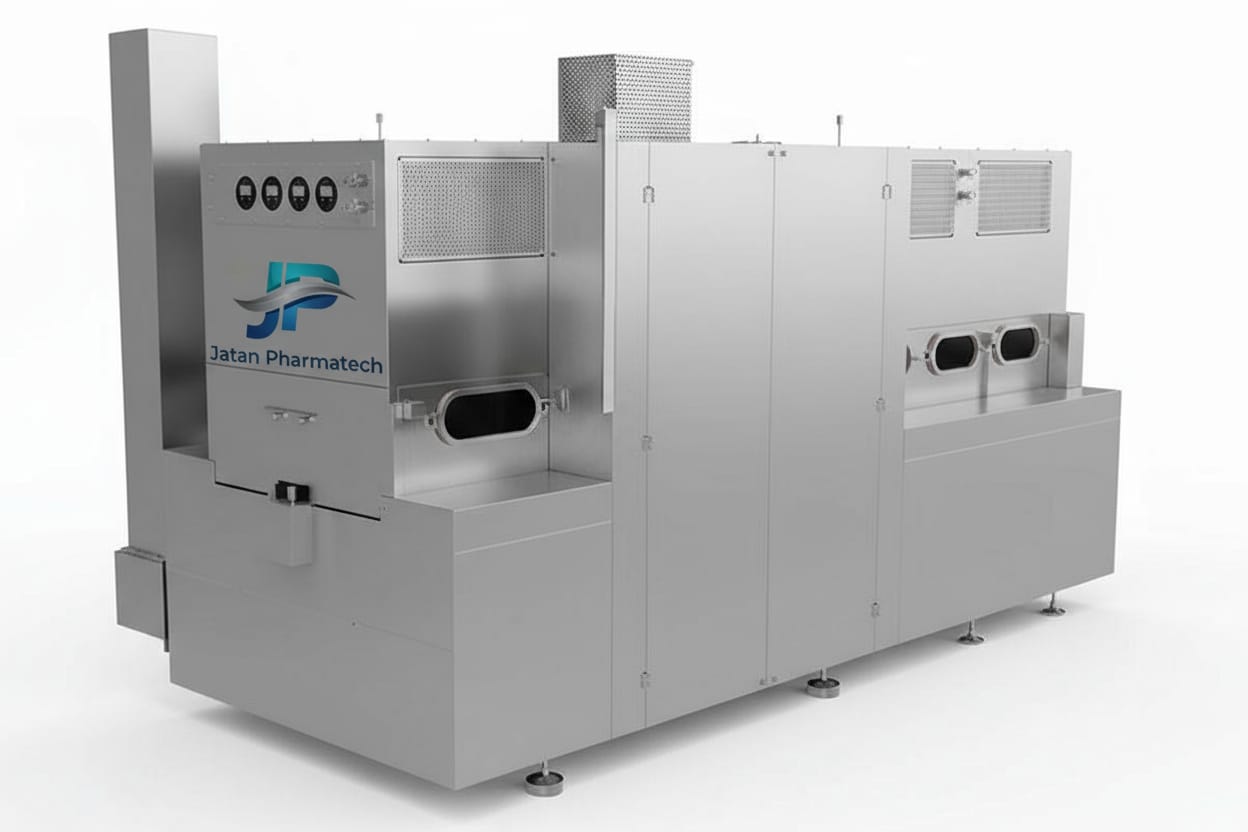
A sterilization tunnel is a highly specialized piece of equipment used primarily in pharmaceutical manufacturing to achieve continuous, reliable sterilization and depyrogenation of glass containers such as ampoules, vials, syringes, and cartridges. This process is vital to ensure the sterility and safety of products destined for aseptic filling, helping to meet strict regulatory and pharmacopeial standards for injectable medications and biological products.
Principle and Operation
- Sterilization tunnels operate using the dry heat principle, whereby filtered hot air (typically at 250–350°C) is blown through glassware moving on a conveyor belt system. The process is divided into multiple zones:
- Drying Zone: Removes residual water from washed containers.
- Hot Zone: Exposes containers to high temperatures for sterilization and depyrogenation.
- Cooling Zone: Reduces the temperature of containers before they exit the tunnel and proceed to filling areas.
Uniform hot air circulation, achieved by forced convection via HEPA filters, guarantees consistent temperatures and thorough sterilization across all containers. Modern systems maintain an ISO 5 cleanroom environment throughout the tunnel’s length and width. Pressure and airflow are precisely controlled to prevent contamination and ensure a validated sterile outcome.
Features and Benefits
- Continuous automatic operation, supporting high throughput for integration into large production lines.
- Modular and compact designs allow for flexible plant layouts and easier maintenance.
- Automated control and monitoring systems (often with SCADA or 21 CFR Part 11 compliance), enabling reproducible and auditable processes.
- Proven efficacy in reducing microbial and endotoxin (pyrogen) levels, with many tunnels achieving at least a 3-log (1,000:1) or higher reduction in endotoxin content.
- Minimal risk of glass damage due to built-in air cooling and gentle conveyor handling.
Applications
Sterilization tunnels are essential for:
- Sterilizing and depyrogenating glass vials, ampoules, and cartridges for injectable pharmaceuticals.
- Maintaining product safety and regulatory compliance in parenteral (injectable) drug manufacturing environments.
- Creating seamless sterile transfer from washing to filling lines while maintaining a controlled cleanroom environment.
Validation and Control
- Validation procedures rely on sensors and biological indicators to monitor temperature distribution and sterilization effectiveness throughout the tunnel. Continuous monitoring ensures that all containers receive adequate heat exposure with minimal temperature variation and effective reduction of endotoxins and other contaminants.
- Validation procedures rely on sensors and biological indicators to monitor temperature distribution and sterilization effectiveness throughout the tunnel. Continuous monitoring ensures that all containers receive adequate heat exposure with minimal temperature variation and effective reduction of endotoxins and other contaminants.